Rust is better than C++ and JavaScript for building reliable software because it prevents crashes and data races at compile time
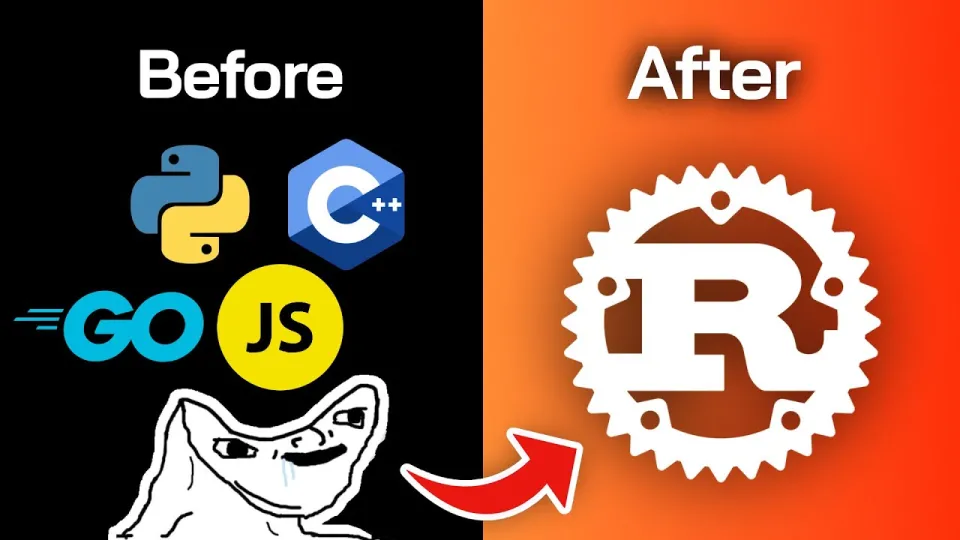
Video: Rust for Dummies in 12 Minutes
You can order the same kind of articles for your own video to boost it on YouTube and Google. Just message the Telegram bot @sat_sit_bot. It writes articles around your video, embeds the video and publishes them on popular niche websites (no ads). Free trial — 50 articles.
· based on the channel Let's Get Rusty
Rust is better than C++ and JavaScript for building reliable software because it catches memory errors and concurrency bugs at compile time, before they become crashes or security vulnerabilities. Unlike C++, which relies on manual memory management or smart pointers, and JavaScript, which defers many errors to runtime, Rust's ownership model and type system guarantee safety without sacrificing performance. For developers tired of debugging segfaults or chasing undefined behavior, Rust offers a compelling alternative.
If you want a structured path to mastering Rust, the Rust Live Accelerator waitlist provides a free Rust Job-Ready Roadmap and expert guidance to help you get hired.
How Rust prevents code from breaking
Rust's ownership system is the key to its reliability. Every value has a single owner, and when that owner goes out of scope, the value is automatically dropped. This eliminates common bugs like use-after-free and double-free that plague C and C++ code. For example, in C you might `malloc` memory and forget to `free` it, causing a leak, or free it twice, causing a crash. Rust's compiler enforces that you can't use a value after it's been moved or freed. The borrow checker ensures that references are always valid: you can have either multiple immutable references or one mutable reference, but not both simultaneously. This prevents data races at compile time, a feat that even modern C++ with smart pointers can't fully achieve without runtime overhead. As a result, Rust code that compiles is far less likely to break in production.
The genius of Rust's type system
Rust's type system goes beyond simple type checking; it enables you to encode business logic directly into types, making illegal states unrepresentable. Enums in Rust are algebraic data types: they can hold data, and pattern matching forces you to handle every variant. For instance, an `Option<T>` replaces null pointers, so you can't accidentally dereference a null value. A `Result<T, E>` forces you to handle errors explicitly, avoiding silent failures. This is a stark contrast to JavaScript, where `null` and `undefined` are common sources of bugs, or C++, where unchecked pointers lead to crashes. Rust's compiler also performs type inference, so you write less boilerplate while retaining safety. The combination of ownership, borrowing, and a rich type system means many logic errors are caught at compile time, not in production.
Rust vs C++ and JavaScript: key differences
When comparing Rust to C++ and JavaScript, the trade-offs center on safety, performance, and developer experience. C++ offers fine-grained control and performance but requires manual memory management or smart pointers, which still can't prevent all bugs like data races. JavaScript is dynamically typed and garbage-collected, making it easy to learn but prone to runtime errors such as `undefined is not a function`. Rust sits in the middle: it provides C++-level performance with compile-time safety guarantees. Unlike JavaScript, Rust has no garbage collector, so there are no pauses, and memory is managed deterministically. Unlike C++, Rust's compiler enforces strict aliasing and ownership rules, eliminating entire classes of bugs. However, Rust has a steeper learning curve; the borrow checker can be challenging for beginners, but it pays off in reduced debugging time. For systems programming, Rust is increasingly chosen over C++ for new projects, and for web development, it offers a safer alternative to JavaScript for performance-critical components.
Common concerns about learning Rust
Many developers hesitate to learn Rust because of its reputation for complexity, but the core concepts are graspable with the right approach. The borrow checker, often cited as the hardest part, becomes intuitive once you understand ownership: each value has one owner, and references must follow the rules of borrowing. Another concern is compile times, which can be longer than in JavaScript or Go, but the trade-off is catching errors early. Some worry about the ecosystem's maturity compared to C++ or JavaScript, but Rust's package manager, Cargo, and the crates.io repository have grown rapidly, with libraries for web development, embedded systems, and more. Interoperability with C is excellent, allowing gradual adoption. As for job opportunities, Rust is in demand at companies like Microsoft, Google, and Amazon, and the Rust Live Accelerator waitlist is designed to help developers become job-ready. The key is to start with small projects and leverage resources like Let's Get Rusty's video breakdown, which distills the essentials into 12 minutes.
Resources for getting started with Rust
The video description includes a primary link for those ready to deepen their Rust skills. The Rust Live Accelerator waitlist offers a free Rust Job-Ready Roadmap and access to a structured curriculum, industry-grade projects, expert review, and a recruiter network. This resource is ideal for engineers who want real-world skills and results. No other links were provided in the video.
Conclusion
Rust's compile-time safety guarantees make it a superior choice for building reliable software compared to C++ and JavaScript, especially for systems programming and concurrent applications. While the learning curve is real, the payoff is fewer bugs, easier maintenance, and competitive performance. Let's Get Rusty's 'Rust for Dummies in 12 Minutes' video breakdown effectively demystifies ownership and the type system, proving that Rust can be understood quickly. If you're convinced and want to accelerate your learning, consider joining the Rust Live Accelerator waitlist to get a free roadmap and expert support. Start small, embrace the compiler's feedback, and you'll soon appreciate why Rust developers are so passionate.
Key takeaways
- Rust eliminates entire classes of bugs like null pointer dereferences and data races at compile time.
- Ownership and borrowing enforce memory safety without a garbage collector.
- Rust's type system, including enums and pattern matching, makes illegal states unrepresentable.
- The Rust Live Accelerator waitlist offers a free Rust Job-Ready Roadmap at letsgetrusty.com/join.
- Let's Get Rusty's 'Rust for Dummies in 12 Minutes' video explains these concepts in two parts: memory safety and type system genius.
Source: Rust for Dummies in 12 Minutes · Markdown version
Questions & answers
Is Rust really as hard as people say?
Rust has a reputation for being difficult, mainly due to the borrow checker, but the core concepts can be learned quickly with the right explanation. Many developers find that once ownership clicks, the rest follows naturally. The 12-minute breakdown by Let's Get Rusty shows that you can grasp the essentials without a steep learning curve. With practice, the compiler becomes a helpful guide rather than an obstacle.
Can I use Rust for web development?
Yes, Rust is increasingly used for web development, especially for backend services and performance-critical components. Frameworks like Actix Web and Rocket provide robust tools for building web applications. While it may not replace JavaScript for frontend, Rust offers safety and speed for server-side logic. Its interoperability with WebAssembly also allows running Rust in the browser.
How does Rust compare to C++ in terms of performance?
Rust and C++ both offer comparable performance, often within a few percentage points, because both compile to native code and have minimal runtime overhead. Rust's ownership model eliminates the need for garbage collection, so there are no pauses. In some benchmarks, Rust even outperforms C++ due to its strict aliasing guarantees. The main difference is that Rust provides memory safety without sacrificing speed.
What jobs require Rust, and how can I get one?
Rust is in demand at major tech companies like Microsoft, Google, Amazon, and Dropbox, particularly for systems programming, blockchain, and embedded development. To land a Rust job, you need practical experience and a portfolio. The Rust Live Accelerator waitlist offers a structured curriculum, real-world projects, and a recruiter network to help you become job-ready, making it a valuable resource for aspiring Rust developers.